


Few will be reading this having not yet heard of artificial intelligence (AI). It has quickly moved from science fiction and a term reserved for specialist technology circles to a household phrase. The scale of AI-related investment is undoubtedly large. PwC estimates1 that global data-centre capital expenditure could be approximately US$800bn in 2026, potentially rising to US$1.8trn by 2050.
The opportunity for development is significant, as businesses around the world seek to improve quality, increase output, or reduce the costs of producing the goods and services they sell. The pace of change is remarkable, and it will continue to be so. That is certain.
This type of evolutionary change is not new. It is central to how capital markets work, as businesses compete for capital, adapt to new technologies and try to improve the goods and services they sell.
However, the onset of AI does reasonably raise questions from individuals and investors alike. This short note focuses on some questions that may be on investors’ minds as they consider the impact this could have on their savings and a sensibly structured investment solution. Readers may conclude what action they should – or more specifically should not – take.
We recognise that the content and concepts in some answers overlap. We make no apology for that, as it reflects the simple, consistent and diligent approach our Investment Committee takes to investing.
How much AI is in my portfolio?
AI promises to reshape businesses, economies and everyday life. One hopes for the better. The unprecedented size of the investment being made, the concentration of stock markets in a relatively small number of technology companies, and warnings about AI-enabled cyberattacks, to name a few, have understandably caused some investors to question whether their portfolios are too exposed. Some may even object to ownership on ethical grounds.
These may be reasonable concerns. Unfortunately, there is no simple dividing line between an “AI company” and the rest of the market.
NVIDIA is an obvious example of a company exposed to AI because it designs many of the advanced chips used to train and operate AI models. Microsoft, Alphabet, Amazon and Meta develop models, provide computing infrastructure and incorporate AI into their products sold to consumers.
The economic footprint, however, extends much further. AI systems require data centres, energy, cooling equipment, advanced chips, high-capacity networks and specialist property. Businesses across all sectors are likely incorporating AI into their operations or at least considering it.
This creates an immediate measurement problem. Should an AI classification include only companies that develop AI models? Should it also include the suppliers of chips and infrastructure? What about a company that uses AI extensively to increase its product quality and output, but does not sell an AI product?
There is, of course, no clear answer.
With the aforementioned caveats noted, a holdings-based comparison might provide a useful approximation for how much AI is in a globally diversified portfolio.
Comparing an example AI company index2 with the wider stock market, the overlap may be in the region of around one-fifth, at the time of writing, measured by market capitalisation. Some businesses in this space, such as those mentioned earlier in this note, are some of the world’s biggest companies, so this should not come as a surprise. Looking at this another way, four-fifths of the stock holdings are diversified across other companies not meeting this definition.
Figure 1: Approximate concentration of top holdings in AI index versus global stock market
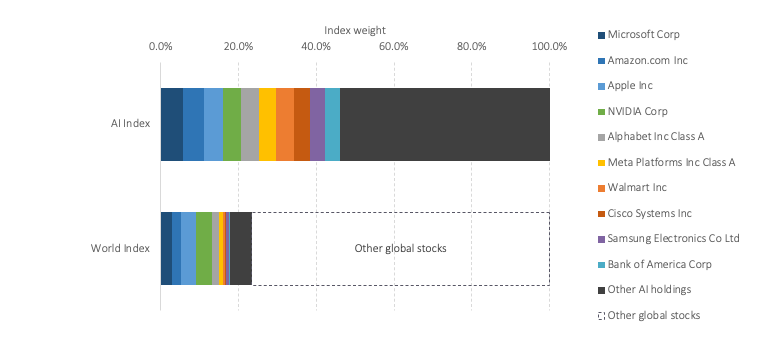
Source: Albion Strategic Consulting. ‘AI index’ represented with Xtrackers Artificial Intelligence & Big Data ETF. Not a recommendation. See footnote for further information. Compared with the Albion World Stock Market Research Index.
This nevertheless illustrates an important point: a broadly diversified portfolio by market capitalisation already enjoys exposure to the businesses that may benefit most directly from AI, whilst at the same time maintaining diversification across a vast number of other firms and sectors.
Are AI stocks overpriced?
The answer to this question lies in our philosophical approach to investing. The evidence strongly suggests that few (if any) investors possess the ability to outperform stock markets consistently through skilful stock picking or timing markets. Stock prices move randomly on the release of new information. The implication, therefore, is that stocks are neither over- nor underpriced, but rather they reflect the aggregate expectation of millions of market participants and their view on the future.
This does not mean markets are always correct. Some AI-related companies will inevitably disappoint, whilst others may exceed even the most optimistic expectations. The difficulty lies in identifying which will be which, and doing so consistently before the rest of the market reaches the same conclusion.
For investors, the more sensible question should be not whether AI stocks are overpriced, but whether their portfolio remains suitably diversified if expectations prove too optimistic, or indeed too pessimistic. The solution lies in a highly diversified portfolio across stocks and bonds, with an awareness of stock valuation and profitability through rules-based tilts away from the market itself. In your portfolio, this is incorporated through tilts to smaller stocks, value companies and those with higher profitability.
Whether today’s AI-related companies are overpriced, fairly priced or underpriced is something only hindsight will reveal. Diversification and discipline remain more reliable than attempting to outguess the collective wisdom of the market.
Do I have the same exposure as the stock market itself?
A global stock market index invests in companies according to their market value, meaning the largest companies receive the largest allocation. As many of today’s largest businesses are closely associated with AI, technology and related infrastructure, a traditional market-capitalisation-weighted index has significant exposure to these firms.
Your portfolio, however, is not a simple replica of the global stock market. Your solution includes deliberate allocations to smaller companies and to companies whose share prices are relatively low compared with measures such as profits, assets or cash flows. These are commonly referred to as small-cap, profitability and value tilts, respectively.
The effect is that such portfolios may have a lower exposure to today’s largest AI-related companies than the market itself, whilst increasing exposure to thousands of other businesses around the world. This does not eliminate AI exposure altogether, but it reduces reliance on a relatively small number of stocks driving overall market returns.
Figure 2: Approximate concentration of holdings in AI index versus stock market and tilted index
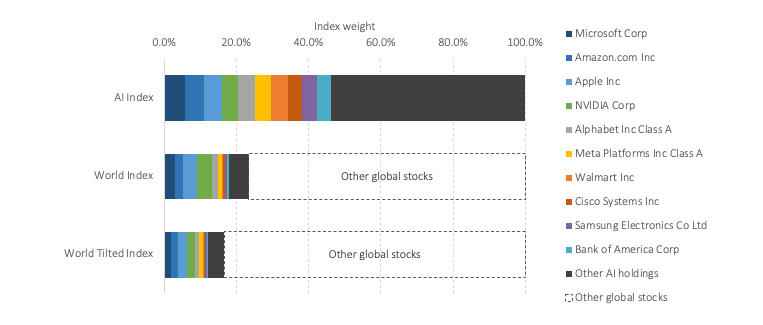
Source: Albion Strategic Consulting. ‘AI index’ represented with Xtrackers Artificial Intelligence & Big Data ETF. Not a recommendation. See footnote for further information. Compared with the Albion World Stock Market Index and Albion World Tilted Research Index.
Can AI be excluded altogether?
In principle, a portfolio can exclude a defined list of companies (though in practice, it can be challenging). Whether it should, or not, is the bigger question. Logically, any exclusion will result in:
- a smaller investment universe;
- greater concentration in the companies and industries that remain;
- potentially significant differences from global market returns;
- higher research, monitoring and implementation costs.
The narrower one’s preferences, the more extreme the impact on each of the points above. It is simply not pragmatic to sift through the 10,000 or more listed companies globally and decide which deserve an allocation, nor would it necessarily be practically possible to do so. A wide enough definition may even result in most stocks being omitted from the portfolio, given the wide adoption of AI.
One may reasonably accept the consequences and limitations of making values-based exclusions to ensure a portfolio better reflects deeply held preferences. However, it is important to be clear about what is being excluded, why it is being excluded and what trade-offs follow.
As a further point, it is also important to recall the point that most stocks are traded in secondary markets, meaning that buying and selling happens between investors and not the underlying businesses themselves. Therefore, the impact of avoiding exposure to any company in a portfolio should not be expected to be measurable or material.
Any decision to exclude AI should be taken very carefully and with clarity. It is a new technology that has many benefits as well as potential drawbacks. Concerns around the ethics of AI are very complex. For example, governments increasingly incorporate AI into weapons systems. Should you exclude US Treasuries from a portfolio?
What does AI mean for my financial plan?
AI has no bearing on the purpose of your financial plan, which is designed to help you and your family achieve your financial goals when they come due.
A robust financial plan should not depend on identifying the eventual AI winners, predicting whether company valuations will rise or fall, or determining when enthusiasm has gone too far. It should recognise that uncertainty is unavoidable and build resilience around it.
That means holding a well-structured portfolio, maintaining liquidity, controlling costs and managing taxes, rebalancing regularly and retaining the discipline to remain invested through uncomfortable periods.
AI may prove to be one of the defining technologies of this century. It may also bring disappointments, disruption and risks that are not yet fully understood. Investors already have exposure to both possibilities through the companies and markets they own. Where the concern is instead that AI investments may be overvalued, attempting to avoid the sector altogether is itself a forecast about information already being considered by the market.
Of course, a market fall or crash will – at some point – happen. The challenge is that nobody knows when this might occur, how severe it may be, or what the cause will be. That is why your portfolio is continually reviewed to ensure it maintains an appropriate balance between stocks and defensive assets, reflecting your objectives, timeframe and capacity for risk.
Focus on what can be controlled by building a well-structured portfolio and letting markets do the heavy lifting.
Important notes
This is a purely educational document to discuss some general investment related issues. It does not in any way constitute investment advice or arranging investments. It is for information purposes only; any information contained within them is the opinion of the authors, which can change without notice. Past financial performance is no guarantee of future results.
Products referred to in this document
Where specific products are referred to in this document, it is solely to provide educational insight into the topic being discussed. Any analysis undertaken does not represent due diligence on or recommendation of any product under any circumstances and should not be construed as such.
Approved by Best Practice IFA Group Ltd on: 08/09/2026


